How Custom GPTs are Redefining Workflow Automation for Modern Agencies
Authored By
CEO & Founder
Published
May 24, 2026
Reading Time
2 min read
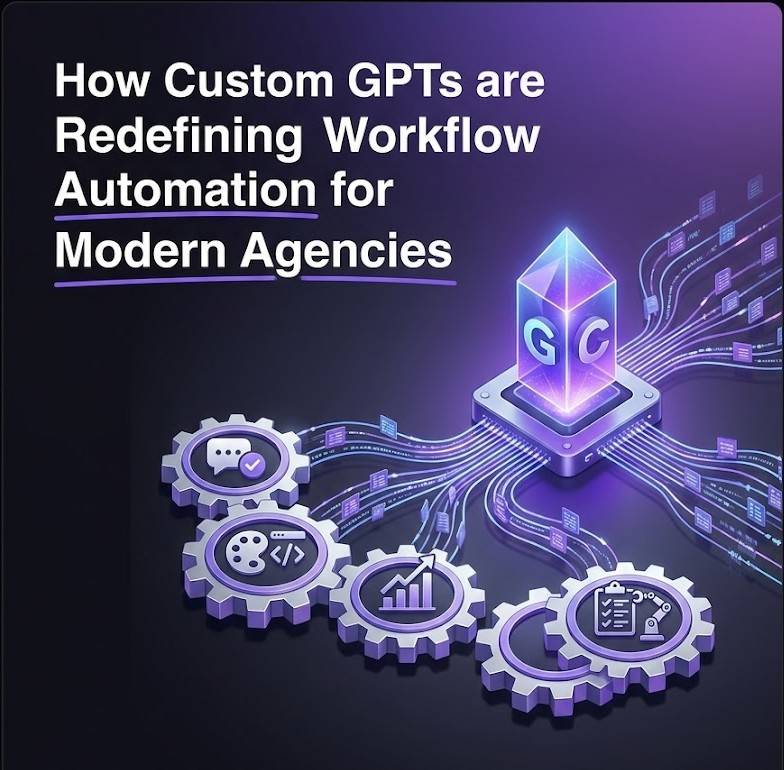
The landscape of digital productivity is undergoing a massive shift. While off-the-shelf AI tools have given businesses a baseline efficiency boost, the real competitive advantage now belongs to organizations utilizing proprietary, specialized AI intelligence: **Custom GPTs**.
For modern brands and agencies, generic prompts are no longer enough. To truly scale, internal operational workflows require tailored systems that understand specific brand voices, technical infrastructures, and unique data sets.
### What is a Custom GPT?
Unlike standard conversational AI models, a Custom GPT is a specialized instance of an artificial intelligence engine tailored to handle distinct operations. By securely training these models on your proprietary business documentation—such as customer standard operating procedures (SOPs), legacy codebases, or brand design guidelines—they become highly contextual internal assets.
### Key Areas of Impact for Digital Teams
#### 1. Hyper-Personalized Customer Support
Integrating a tailored AI assistant into your client communication channels changes the game. Instead of relying on rigid, frustrating fallback trees, an trained bot reads and synthesizes internal knowledge bases instantaneously, resolving complex client queries with unmatched human-like precision.
#### 2. Scalable Content Production & Brand Alignment
Maintaining a unified voice across multi-channel creative campaigns can become chaotic. Custom GPTs can act as an automated brand guardian, instantly checking or rewriting ad copy, website layouts, and email funnels to perfectly mirror a company's specific tone guidelines.
#### 3. Streamlined Development and Engineering Pipelines
For development teams, specialized models can scan existing repositories to generate boilerplate code chunks, debug custom scripts, and cross-reference API documentation. This significantly shrinks development cycles and eliminates repetitive backend coding bottlenecks.
### The Bottom Line
Implementing intelligent automation isn’t about replacing human talent—it's about multiplying their capacity. By offloading resource-heavy data retrieval and repetitive administrative tasks to custom-tailored AI engines, agencies free their teams to focus entirely on high-level strategy and creative innovation.